You’ve felt it before; your heart races. Your mind spins. You want to slow down but don’t know how. Then you remember, just breathe.
Breathing isn’t just something your body does on autopilot. It’s one of the most powerful ways to calm your system when you feel anxious, overwhelmed, or disconnected. You don’t need fancy tools or a perfect environment, just your breath.
In this blog, we’ll explore different breathing techniques like box breathing, 4‑7‑8 breath, cyclic sighing, alternate nostril breathing, and humming breath. These tools are simple, backed by research, and help you reconnect with your body when the world feels too loud.
Why Breath Helps You Feel Safe
When you feel stressed or anxious, your body flips on its alert system. This is called the fight-or-flight response. It helps in emergencies, but when it stays on too long, it can wear you down.
Slow, steady breathing helps turn on the rest-and-digest system, which brings you back into a state of calm [1], and digestion. This part of your nervous system tells your body, “You’re safe now. You can relax.” It’s a gentle but powerful way to regulate emotions.
Which Breathing Technique to Try, and When
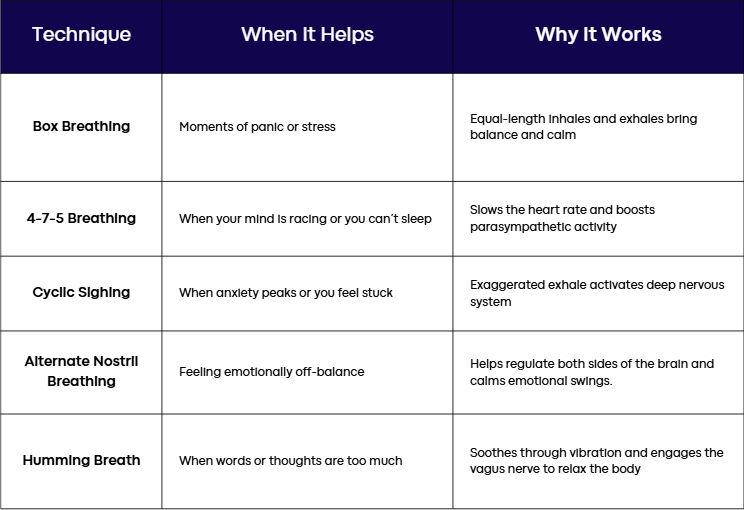
How to Try Each Technique
Here are five gentle breathing exercises. You can try them anywhere, before bed, in the car, or even during a stressful moment at work.
Box Breathing
Athletes and first responders use this technique. It creates a steady rhythm that helps your body relax.
- Inhale through your nose for 4 counts
- Hold your breath for 4 counts
- Exhale through your mouth for 4 counts
- Hold again for 4 counts
- Repeat for 1 to 3 minutes
4‑7‑8 Breath
This one is great for bedtime or calming your mind when it feels busy.
- Inhale through your nose for 4 seconds
- Hold for 7 seconds
- Exhale slowly through your mouth for 8 seconds
- Repeat 4 times
Cyclic Sighing
This breath pattern works by making your exhale longer than your inhale. That helps settle your nervous system fast.
- Take one deep breath through your nose
- Add a second short inhale right after
- Let it out slowly through your mouth with a sigh
- Repeat for 3 to 5 rounds
Alternate Nostril Breathing
This technique can help with focus and balance. It’s often used in yoga.
- Close your right nostril with your thumb and inhale through the left
- Close your left nostril with your ring finger and exhale through the right
- Inhale through the right, then switch and exhale through the left
- Keep alternating for 1 to 3 minutes
Humming Breath
This breath is soft and calming. The vibration from the hum relaxes your chest and jaw.
- Inhale gently through your nose
- Exhale slowly while humming
- Feel the vibration through your body
- Try this for about a minute
What the Research Says
Breathing is more than a mindfulness trend. Studies show that specific breathing patterns help reduce stress, support your heart, and improve mood.
- A study found that structured breathing like box breathing activates the parasympathetic nervous system, increases heart rate variability (HRV), a sign of a resilient nervous system, and lowers stress hormones [2].
- A Stanford study found that cyclic sighing, a technique that focuses on long exhales, is one of the most effective ways to reduce anxiety in just minutes [3].
- Paced breathing at six breaths per minute has been linked to better emotional balance and even better heart health [4].
- The 4-7-8 breathing technique was found to significantly reduce anxiety levels and improve quality of life in patients following bariatric surgery, highlighting its clinical value in managing emotional distress [5]. These aren’t just relaxing tricks. They’re grounded in science.
Breathwork and Therapy: A Supportive Team
At MindShift Integrative Therapy Centre, we often blend breathing practices into therapy for anxiety, trauma, and stress. These tools help your body learn that safety is possible, even when your thoughts are racing.
Breathwork doesn’t fix everything. But it offers a doorway into your healing process. If you’re starting therapy or already working with one of our therapists, breathing exercises can be part of how you reconnect with yourself.
We offer individual therapy, anxiety therapy, and support for people who want to feel more present, grounded, and emotionally safe.
You’re Not Weak. You’re Relearning Safety.
You don’t need to control every emotion. You don’t have to feel calm all the time. But learning to pause and breathe can be one of the kindest things you offer yourself.
It’s okay to take up space. It’s okay to slow down. And it’s more than okay to start with just one breath.
If you’re curious about how therapy and breathwork can support you, our team at MindShift Integrative Therapy Centre is here to walk with you.
Frequently Asked Questions:
Breathwork is a powerful support tool, but it works best alongside therapy rather than as a replacement. It helps regulate your nervous system in the moment, while therapy addresses the deeper patterns and experiences driving anxiety. Together, they tend to be more effective than either on its own.
Not at all. It is more helpful to find one or two that feel natural to you and practise those regularly than to rotate through all five. Start with whichever one feels easiest and build from there.
Yes, though it can feel hard to remember in the moment. Box breathing and cyclic sighing are especially useful because they give your mind something steady to follow. If a full technique feels like too much, simply slowing your exhale down is enough to begin shifting your nervous system out of high alert.
Sources:
- The University of Toledo. “deep breathing and relaxation.” University Counseling Center, n.d. https://www.utoledo.edu/studentaffairs/counseling/anxietytoolbox/breathingandrelaxation.html
- Balban, M.Y., Neri, E., Kogon. M.M. et al. “Brief structured respiration practices enhance mood and reduce physiological arousal.” PudbMed Central, 2023. doi: 10.1016/j.xcrm.2022.100895
- Leggett, H. “’Cyclic sighing’ can help breathe away anxiety.” Stanford Medicine, 2023. https://med.stanford.edu/news/insights/2023/02/cyclic-sighing-can-help-breathe-away-anxiety.html
- Deepeshwar, S., Budhi, R.B. “Slow yoga breathing improves mental load in working memory performance and cardiac activity among yoga practitioners.” Frontiers, 2022. https://doi.org/10.3389/fpsyg.2022.968858
- Aktas, G.K., Ilgin, V.E. “The Effect of Deep Breathing Exercise and 4-7-8 Breathing Techniques Applied to Patients After Bariatric Surgery on Anxiety and Quality of Life.” PubMed, 2023. doi: 10.1007/s11695-022-06405-1.