Knowing your love language is often presented as the key to feeling more loved. But for many people, learning their love language does not actually change how they feel in their relationship.
You might know your love language clearly and still feel emotionally unmet. You might be doing your partner’s love language consistently and still feel disconnected. Or you may feel like you keep missing each other, no matter how much effort is put in.
When this happens, it can show up as emotional loneliness even while in a relationship. You may feel hurt when certain needs are missed, frustrated that “doing the right things” does not change how you feel, or confused about why reassurance or effort never quite feels like enough.
At this stage, it can seem like a communication problem. But when the same pain keeps repeating, it often points to something deeper than preference, effort, or knowing the right framework.
This is often where people start to look beyond love languages and consider deeper support.
What Are the 5 Love Languages (and What Were They Meant to Explain)?
The Five Love Languages framework was created by Gary Chapman. It became popular because it gave people a simple way to talk about emotional needs. For many, it was the first time they had language for why certain things mattered so much to them.
The 5 Love Languages describe common ways people tend to give and receive care:
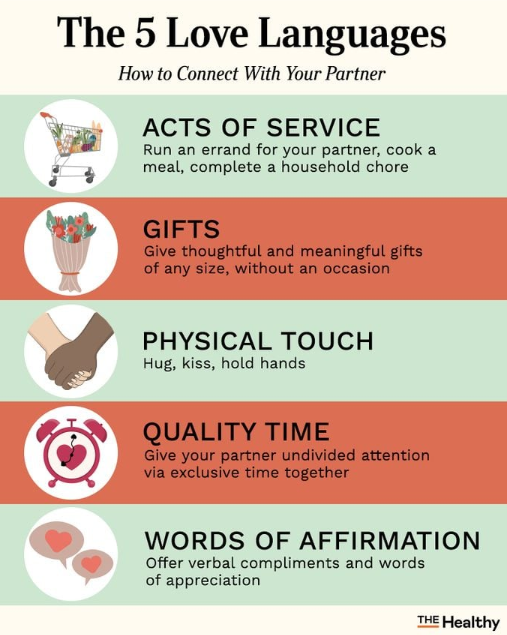
Image Source: The Healthy
The framework was originally created to explain why people can care deeply for one another and still feel disconnected. People often express love in the way they most want to receive it, which can lead to misunderstandings when partners have different preferences [1].
Love languages are best understood as preferences, not fixed traits or guarantees of relationship satisfaction. They can be useful for starting conversations, but they are not a complete explanation of emotional connection.
The love languages offered a shortcut. They helped people say, “This is how I feel cared for.” Most people relate to more than one. Many people shift over time. Stress, life stages, and emotional safety all affect what feels meaningful.
But simple tools can become confusing when they are treated as rules instead of guides.
When Knowing Your Love Language Doesn’t Change How You Feel
For many people, the problem is not understanding their love language. It is that the emotional response does not shift, even when the language is known and used.
You might recognize your need for reassurance, yet still feel anxious when it is offered. You might value time together, yet still feel distant afterward. You might receive affection, help, or thoughtfulness, but notice that it does not settle you for long.
This can lead to more confusion.
If I know what I need, why doesn’t it help? If my partner is trying, why do I still feel this way?
At this point, love language struggles feel like a communication issue. Something is not landing. Something keeps missing. But it is not yet clear what or why.
The Repeating Pattern Many Couples Get Stuck In
Over time, couples often find themselves in the same loop.
One person feels unseen or unloved.
The other feels confused or inadequate.
Both feel like they are trying, yet neither feels secure.
Conversations start sounding familiar.
“I don’t know what you want anymore.”
“I feel like nothing I do is enough.”
“I’m doing my best.”
What makes this especially painful is that effort is there. Care is there. And yet, the emotional gap remains.
This is often where love languages start to feel less helpful and more discouraging.
When Love Languages Start to Feel Like Pressure
For some people, love languages slowly turn into another way to feel wrong.
If you already feel unseen, being told “your needs are just different” can feel isolating. If you are the one trying to meet your partner’s needs, it can feel exhausting when nothing seems to land.
Love languages can also turn into quiet scorekeeping. Effort gets measured. Resentment builds. The relationship starts to feel tense rather than supportive.
When this happens, the issue is often not about knowing the right language; it is about why the same dynamic keeps repeating.
How Upbringing Shapes How Each Partner Experiences Love
This is where upbringing begins to matter.
Long before adult relationships, each person learns what love feels like through early experiences. Some people grew up in homes where affection was consistent and emotional needs were noticed. Others grew up learning to stay quiet, be useful, manage others’ emotions, or not ask for too much.
These early lessons shape how love is experienced later on.
One partner may have learned that love shows up through action, responsibility, or providing. The other may have learned that love feels safe when emotions are acknowledged and reassurance is offered. Neither is wrong, but they come from different emotional worlds.
When these two upbringings meet in a relationship, love languages can clash not because the languages are wrong, but because each person’s nervous system expects love to feel a certain way.
Why Doing “The Right Love Language” Still Doesn’t Fix It
This is often the most confusing part for couples.
A partner may genuinely try harder. Behaviour may change. And yet the emotional response does not.
That is because love languages describe behaviours, not how safe love feels internally. If one partner learned early on that love was unpredictable or conditional, even consistent care may not feel settling. If the other learned that love was practical rather than emotional, emotional requests may feel overwhelming or unclear.
The result is a mismatch that no amount of “doing it right” can fully resolve on its own.
This does not mean either partner is broken. It means the relationship is carrying two different relational histories at the same time.
When It Might Be Helpful to Look Beneath the Love Language
If you notice that love language conversations keep leading back to the same frustration, feeling unloved, misunderstood, or unsure whether your needs are reasonable, it may be a sign that the issue is deeper than communication style.
At this point, some people begin to explore their own upbringing, their partner’s upbringing, and how those early experiences are shaping the relationship now.
Not to assign blame. But to understand why certain moments feel so charged, why reassurance does not land, or why closeness feels harder than it should.
How MindShift Integrative Therapy Centre Can Help
Here at MindShift Integrative Therapy Centre, we offer individual therapy and couples therapy for people who feel stuck in patterns of feeling unloved, unseen, or emotionally disconnected, despite knowing their love language.
We focus on understanding how early relational experiences shape present-day relationships. We help clients move beyond surface tools and work through the deeper roots affecting connection, safety, and emotional closeness.
Knowing your love language might help you name the symptom. Therapy helps address the cause.
Frequently Asked Questions:
Not at all. Love languages can be a helpful starting point especially for couples who’ve never talked openly about what makes them feel cared for. The issue is when they’re treated as a complete solution rather than one piece of a bigger picture. They work best as a conversation starter, not a fix.
Sometimes couples mistake a deeper, workable pattern for incompatibility. If both partners are genuinely trying but the emotional gap persists, it’s worth exploring what each person learned about love growing up before drawing conclusions. Compatibility is rarely the whole story.
Either can help. Individual therapy is a good place to start if you want to understand your own patterns and emotional responses first. Couples therapy is useful when both partners are ready to explore the dynamic together. Some people do both at different points, and that’s completely valid.
Sources:
- Olivia Guy-Evans, MSc. “The 5 Love Language Explained” Simply Psychology 2025. https://www.simplypsychology.org/five-love-languages.html